How increasing photosynthesis can help mitigate climate change in agricultural systems.
Agriculture and climate change are two concepts that are becoming more interrelated in public discourse. Articles, films, and books are sharing the story of how agriculture could be used as a tool to help mitigate climate change. Most of these stories focus on carbon emissions as they relate to soil management. A key term you may have come across is “no-till” farming.
So what is “no-till”?
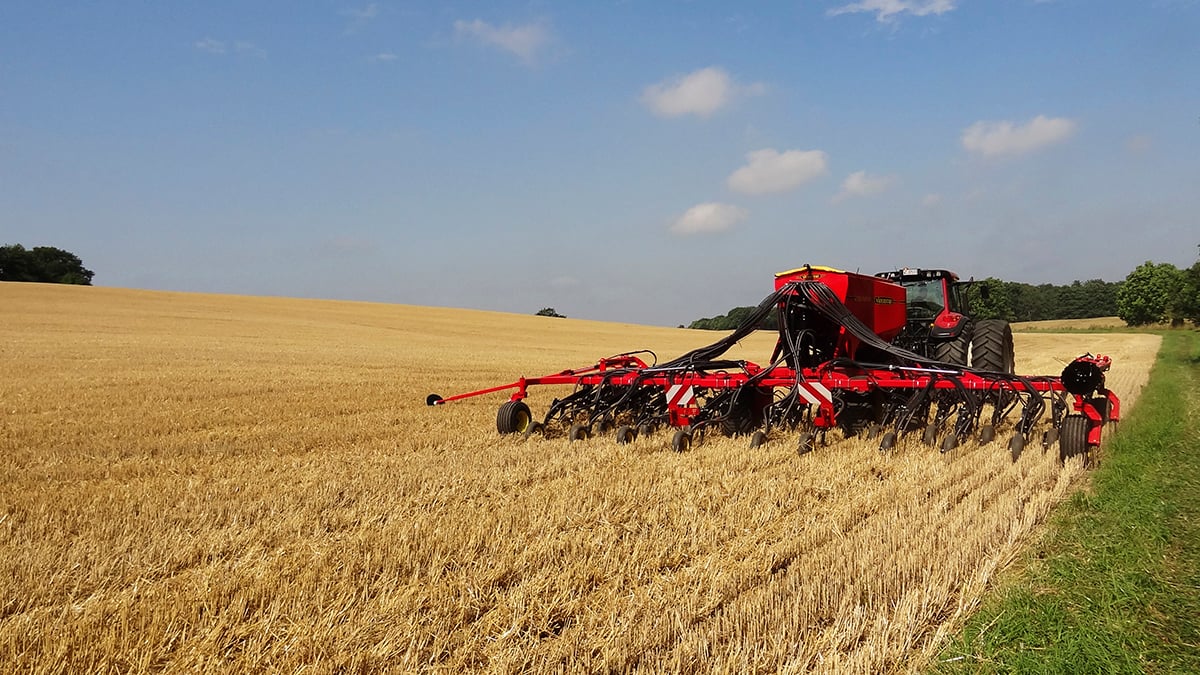
Vanderstad seed drill planting directly into a harvested wheat crop without using tillage.
No-till is a soil management practice that seeks to disturb soil as little as possible in the process of planting and cultivating crops: production. Farmers who practice “no till” are essentially trying to do away with the hallmark of agriculture:” the plough”. During the spring conventional farms plough their fields to eradicate weeds, bury crop debris from the prior season, incorporate fertilizers, and prepare the soil for planting. Bottom line, ploughing is a powerhouse and fundamental farming practice. Doing away with the plough in agricultural systems is no small feat.
Why do we want to get rid of the plough?
While ploughing has many benefits there is an unfortunate downside. Whenever fields are ploughed/tilled, most notably during the spring, massive amounts of carbon are released into the atmosphere. This common agricultural practice is further aggravating the CO2 levels in our atmosphere. No till, or not ploughing, is one strategy to help mitigate the negative climactic impacts of conventional agricultural practices on our atmosphere. In fact, these impacts are now being measured from space.
Nasa has a special satellite called OCO2: Orbiting Carbon Observatory 2. This carbon measuring instrument was launched into orbit in July of 2014. Since that time OCO2 has been monitoring and recording CO2 emissions in Earth’s atmosphere. What we learned from this data is that there is a marked uptick in CO2 levels in the atmosphere every spring.
The visualization is a product of a simulation called a “Nature Run.” The Nature Run ingests real data on atmospheric conditions and the emission of greenhouse gases and both natural and man-made particulates. The model is then left to run on its own and simulate the natural behavior of the Earth’s atmosphere. This Nature Run simulates January 2006 through December 2006.
More interesting though is the decrease in atmospheric CO2 levels as the summer vegetation increases. This decrease seen in July (1:19 in the clip above) is the result of increased photosynthesis. As photosynthesis increases with the flush of summer growth atmospheric carbon decreases. This is because CO2 is one of the dietary staples of leafy plants. This includes agricultural crops such grains, legumes, and forages. These are the main crops grown in Canada.
As agricultural crops mature they begin feeding on large amounts of atmospheric carbon to fuel photosynthesis: plant growth. That carbon is then converted into carbohydrates (sugars) that are released and stored in the soil. Those carbons will remain sequestered in the soil as long as it remains undisturbed: not tilled.

In fact, these sugars – plant exudates – are an integral part of an ancient symbiotic relationship plants have with the soils in which they grow. Billions of soil organisms feed on the plant exudates that are the end result of the photosynthetic process. In turn, these organisms fertilize and enrich the soils with vast amounts of biological activity. More specifically speaking to “no-till” these organisms are responsible for the storage of atmospheric carbon in the soil.
The World Meteorological Organization estimates that human activity is responsible for 41.6 billion tonnes of atmospheric carbon release each year. While we are far from being carbon neutral, it is in the bodies of these trillions of soil organisms that the excessive amounts of carbon being released are ultimately stored. Their bodies are the vessels for storing the billions of tonnes of carbon we release into the atmosphere each year.
When we plough our farmland we are creating the conditions for the release of that carbon back into the atmosphere. This is one contributing factor to why atmospheric carbon increases, as seen in the NASA simulation above, each spring (00:58).
You may ask at this point, “if we have the solution why don’t we just do it?” Let’s take a moment to consider some of the intracies of applying no till systems in conventional agricultural operations.
There are many challenges to adopting no till farming systems. We’ll take a brief look at the boots on the ground reality of this concept. Here are a handful of the challenges of no-till farming:
- Crop debris : Crop debris is any biomass left on the soil surface following harvest. Combines leave behind a swath of mulched crop debris in their wake because these machines are engineered to target only the fruiting body of the plant i.e. grain or bean. Vegetative parts of the plant – those responsible for the dip in atmospheric carbon in July – represent a much larger portion of the plant and are mulched and left on the field. The remaining biomass is prohibitive to the planting implements pulled by the tractor. Further, if you were able to plant into the heavy debris reliable germination cannot be achieved.
- Compaction : A lofty soil that has been recently been turned is a very inviting context for early plant development. Farmers turn i.e. till/plough their soils right before planting to increase nutrient release and loosen compaction in their soils. Compaction can be a result of field tracking (tractor passes), gravity, rainfall, or soil type – some soils are heavier in composition than other’s and compact easier. Without tilling compaction has to be dealt with through planting cover crops.
- Cover crops : Cover crops are field crops that are grown primarily for soil health and do not yield a harvest. No-till systems of farming commonly use cover crops to aerate their soils through bio-tillage. Bio-tillage is the use of plant roots to create pathways in the soil that will help absorb water and provide space for new plant roots to follow in the soil. These crops are chosen for their prolific root structures as a result. Once you have established a healthy cover crop you have to terminate that crop to make room for your cash crop. In order to efficiently eradicate a cover crop harmful herbicides such as Glyphosate need to be used.
- Shorter growing seasons : Another difficulty for the farmer looking to adopt a no till systems. In Canada we have a shorter growing season due to our country’s geography. That means the window for profit is narrower for farmers in the north. Taking precious growing time away from cash crops and incorporating cover crops for the purposes of carbon sequestration and soil heath can undermine and complicate a farmer’s life and bottom line.
- Incorporating fertilizer : Conventionally fertilizer is applied to the soils surface and then incorporated with a ploughing/tilling implement to ensure the expensive fertilizers are reaching their intended destination in the soil profile: the root zone. Gravity is not a reliable delivery mechanism for the incorporation of fertilizer. Nitrogen, the most expensive and volume heavy, if left on a soils surface will convert into an atmospheric gas and burn off the field before a plant has time to absorb it or gravity to sink it. Phosphorus if left on a soils surface will run off the field and into our water ways. This phenomena (eutrophication) has created massive algae blooms that choke the life out of our waterways and great lakes.
- Expensive tools : Just like any business farmers need to purchase infrastructure and equipment to support their operations/business. Purchasing a seed drill (no till planter) and a tractor compatible for running that implement will cost a farmer hundreds of thousands of dollars. So a shift to no till planting can be cost prohibitive to a farm business.
I don’t mean to suggest there aren’t solutions to all of the problems listed above. The intention is to bring the reader into the headspace of a farmer somewhat. From the list above we can begin to appreciate that good ideas create as many problems as they do solutions.
When we indict farmers for contributing negatively to the climate crisis, we are in effect asking a farmers to: become engineers responsible for developing new tools to deal with compaction and crop debris; become a bio chemist to manage the intricacies of sustainable soil fertility practices; become agronomists so that you can manage cover crop integration into profitable cash crops; become a savvy futures trader that can preempt the changes and challenges facing their industry and invest wisely in new equipment according to economic trends; and most of all to single handedly correct the massive systemic issues ingrained in our food production system. A system they paid money to be educated in and inherited.
Surely the responsibility of solving these systemic issues cannot fall entirely at the farmers feet. The folks busily engaged in growing our food all day long. That responsibility falls to the population at large.

An example of the extensive crop residue left on the soil surface after harvesting a corn crop.
This is an us problem not a them problem. A few examples of what these supports do look like: Universities can develop better curriculum to teach future farmers; agricultural organizations can educate themselves to better guide and support more sustainable farming BMPs; experimental farms can run trials based on current practices to understand and begin to solve the practical road blocks no till farming presents; the federal government can fund and prioritize a food system that is climate sensitive and supports farmers in that pursuit i.e. carbon credit and subsidies; each one of us can support out Ontario farmers by purchasing locally grown food. We must all invest in better supports for integrating more climate sensitive farming models if we require that of our food production systems.
You may not be aware of it, but you have likely used something similar to tillage in your own home garden. Every spring our grandmother’s taught us to turn the soil in preparation for that year’s planting. She may have cleared the bed of early season weeds and last year’s vegetative residue. Perhaps covered the surface of the garden with compost or manure. Then proceeded to dig in the compost so that it was incorporated into the soil at a depth most useful for plant roots to reach. With the uptick in interest around homesteading, market gardening, and regenerative agriculture this process may begin to sound familiar to you. These steps all make good sense in a home garden, but when you are managing hundreds, if not thousands, of acres the effects add up.
Keep the soil planted, keep the soil covered, and keep the soil in place.
 Lucas Tingle
Leave a comment